| Read time: 8 mins
As Head of Bereavement Services at Liverpool City Council, Alan Sheldon oversees a large and complex operation delivering between 4 to 5000 cremations, and between 1 and a half and 2,000 burials each year.
Here, he explains how PlotBox transformed cremation and burial booking and paperwork from manual, paper-heavy processes into fully digital workflows - cutting turnaround times, and improving access for staff, funeral directors, and the public.
Meet Liverpool City Council.
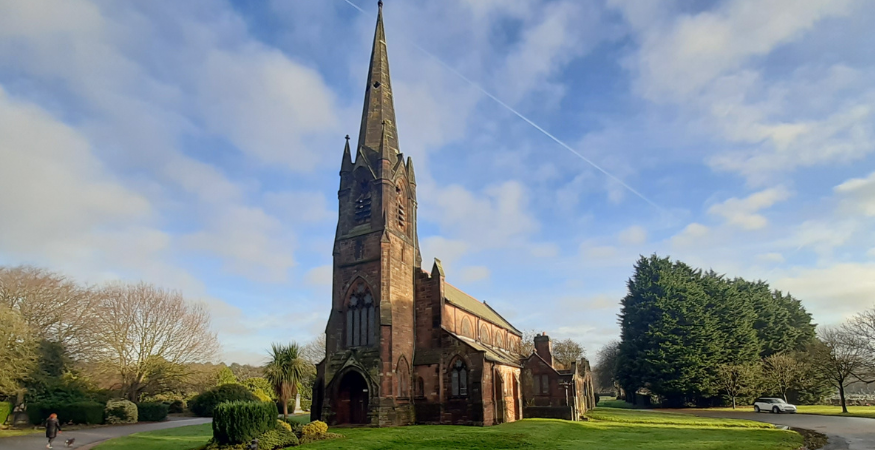
The Liverpool Bereavement Services team consists of 28 people, spread over 4 geographical sites. They have two crematoria sites and 6 cemeteries, totalling 430 acres.
They also have 7 closed churchyards, dotted around the city, while Alan is the manager of the City Mortuary, where he provides a facility for His Majesty's Coroner to carry out post-mortems.
The challenge pre-PlotBox.
Pre-2000, processes were carried out by paper - paper applications, entries into paper registers etc.
In 2000, they introduced our their first digital management system, where the recording of that information was done electronically, with booking still done by phone via their center.
In 2018, they moved to an in-house, bespoke system that Alan and his colleagues designed to digitize bookings, so that funeral directors could book 24-7.
The only problem with that, as Alan says, was when they had to move that data into their management system, they were double handling it.
"The more times you handle a piece of data, the more chances there are of mistakes, or human error.", says Alan.
"Because we would double, sometimes, triple handle data, we needed something that would potentially give us an all-inclusive package."
He continues,
"Our system handles about 4,000 to 5,000 cremations per year. That's all going through one team, and you can imagine the volume of paperwork and such that produces.
When people brought that paperwork into the office, it was a real resource drain.
Now, that's all done electronically. That's been a massive advantage, not only for us - but we're getting great feedback from the funeral directors, who're saying, “We love this new system, it's fantastic”.
In terms of paperwork, another challenge was the tight turnarounds with a crematoria.
Before that paperwork was brought into the office. Now it can just be uploaded straight onto the system, we can then authorise it, check it over…job done."
The solution.
Alan was looking for a product that would give them good mapping, good accessibility for the general public, and good accessibility for users, funeral directors, and memorial masons, as well as a good back-office system that could be tailored to their needs.
Their view was that any solution procured had to be equal or better than what they had already.
"We had a pretty unique, usable system," he says, "But some parts didn't talk to others, and in reality, there wasn't an option to fix that.
So it was difficult because we were running on two separate systems. One was cloud-based, one was hosted. It was all a bit of a mishmash, which, in software, never really works, does it? It needs to have a flow, or it doesn't work."
"The funeral directors love it, Alan goes on. "I thought we'd have a massive challenge with that, and it's been the easiest part of the whole transfer.
We took your training manuals and we ‘Liverpool-ified’ them. We actually did our own training, which was a very simplified version of your training.
We had one face-to-face training session, and two online training sessions and got better take up than we expected. We then kept training for when any new staff came on. So we did our version first, then your version.
We drew them in quite softly to start with, then we gave them the detail afterwards.
Why PlotBox.
Initially, the team carried out a soft market test, sending out a pre-engagement document.
"There was quite a variance in cost, but in reality, we didn't really get anybody who competed with PlotBox.", says Alan.
What threw you onto the next level was the mapping and the interaction with EverAfter.
It’s a game changer."
One example of this was when the team were able to send a link to EverAfter from someone who had inquired from Australia. That person was then able to visit the area and see the grave - even without there being a headstone.
"When you look at it from our point of view," says Alan, "That same grave - we would have had to go and find it, put a lollipop in, and make sure that it was there when they came that day.
So, huge time efficiencies in terms of resource management.
And the beauty with that is it gives us the opportunity to do other things. It's not so much about reducing staffing, it's about making sure your staff are doing what they should be.
And also, we're expanding other things, such as memorialization sales, things like that. We get more time to deal with inquiries now - people wanting to buy a grave etc.
It gives us that opportunity to be closer to the customer.".
How cemetery mapping has helped.
"People can access it from anywhere within the world", says Alan. "Because [Liverpool] is quite a metropolitan, port city, people would ring and say, “Could you tell me where so and so is, I can't get access to this, I can't find this, or I can't do that”.
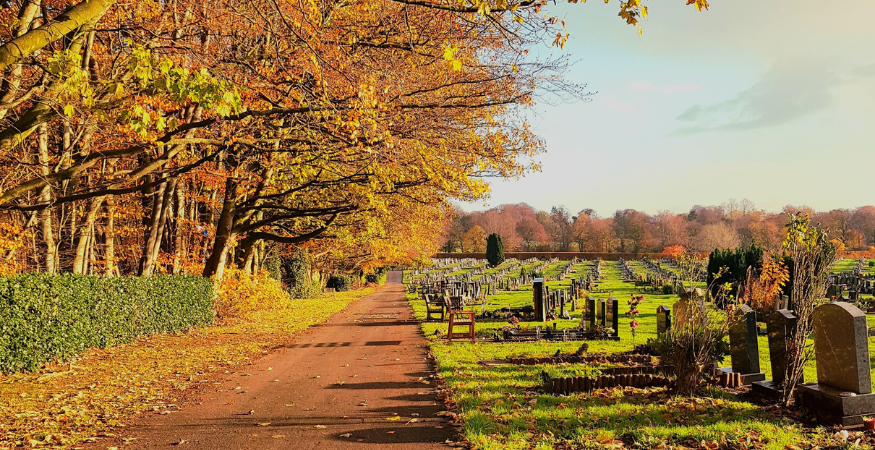
It's a massive win-win. My cemetery manager actually went out to show another member of the team how the app worked, and while they were out, they photographed 300 graves in an hour and uploaded them onto PlotBox."
From an operational perspective, having a picture of the gravestone is a great win for the teams, as in Alan's own words, it provides the, "ultimate data" when looking for the name, age, where they're buried, how many people are in the grave, and so on.
400 memorials per hour.
Alan says, "We had a look, just to see what we could do. My cemetery manager was quite amazed! Not knowing how to do it, the first time she went out, she'd done 45 memorials in 15 minutes.
Now she’s more familiar with it, she’s looking at 3 to 400 memorials in an hour."
The key to cremation bookings.
The team has a diary for each area. One diary for one crematorium, and two diaries for the other crematoria, with two chapels.
That helps in the case of there being a limit to the number of cremations that can be carried out in one day - a maximum of 30 over both sites.
"Initially we didn’t have the ability to cut it off at 18", says Alan, "But the developers took that away, and in very quick time, solved the problem.".
Achieving process efficiencies.
"We’re well ahead of where we need to be.", he continues.
"It’s actually improved our workflow, because everything’s not last minute - we’ve improved our flexibility by 24 hours, which is a game-changer for us.".
Liverpool's books are being scanned and transcribed soon and once uploaded, they'll be able to archive all of them. This will keep them safe and easily accessible.
Key also for Alan for me is the amount of data uploaded that's publicly accessible. "That's immense.", he says.
"It's about making sure that the general public can access it for free. It's not about accessibility at all cost, it's about accessibility for free. And that's what my goal is - to offer as best we can."
Greater data insights.
For Alan, the good thing about the system is that the reporting ability is, "sort of endless.".
"I’ll give you an example, as I was just working on this recently. I met with my accountant to go through the year-end, fees and charges rises for next year, etc.
The advantage we had this time is that we've got data from May of last year through to the end of this month.
We have accurate data on every spend line that we've got. That data then informs our fees and charges increase.
It’s far more intuitive in terms of how we prepare for financial trends and projections."
The reporting functionality is also more intuitive in terms of how long it takes the team to process something. For example, how many cremations did they have? How many were direct cremations? How many were cremations that they would do on a contract basis?
All of those have a different cost, giving far better insight into, for example, how many of those that they don't charge for - t hose that still count as a cremation, but still need to be accounted for.
The other option is when the cremators are being serviced - that's now allowing times to be blocked out.
First class support.
For Alan, when choosing a partner it’s about 70% service, 30% price.
"I can't knock the service that PlotBox offers at all", he says.
"If we get a problem, it doesn't take you long to fix it, which I think's invaluable.
Customer service should be like that. Our customer success manager came along last week, just to touch base on what's happening. We had questions for her, she had some for us and it was nice to meet in person. We sat down, had a coffee, and went through everything.".
Words for other council or local authorities considering a digital transformation.
Alan carried out a lot of amount of research, taking two years to get to this level.
"There's a big consideration whenever you're doing such a huge transfer of documentation and the resources you point to this.", he says.
It doesn't matter whether it's a paper system, a computer system, whatever. But if you're opting for a computer system, opt for the best one.".
His advice to other other authorities is simple.
"Come and see me. Come and see other people who've got the system in place. Come and have a look at what we do. Come and have a look at how we book. I'll make you a funeral director, and you book some slots, just to see how easy it is.
I'm not trying to sell you anything, I'm just telling you what we do."
Finishing on a personal note, he says, "Leona and Sean have put their heart and soul and most of the family into this business. And that goes a long way for me. They should be really proud of themselves. They've built something I'm surmising that’s far above what they ever dreamt it would be.".
Find the right software partner. Download our eBook today:
-2.png)